
After completing Class 12 Science, many students face an important question: What should I do next? Some students want to become doctors, some want to become engineers, and others are interested in computers, Artificial Intelligence (AI), government jobs, or scientific research.
Choosing the right career after 12th Science is an important decision because it can shape your future. However, you do not need to follow the same path as your friends. The best career option depends on your interests, subjects, skills, budget, and future goals.
In this article, we will discuss the best career options after 12th Science in 2026, including courses, eligibility, duration, entrance examinations, and career opportunities.
1. Best Career Options After 12th Science
Science students have many educational and career opportunities. Here are some popular options to consider:
- Engineering
- Medical and Healthcare
- Computer Science and Information Technology
- Artificial Intelligence and Data Science
- Bachelor of Science (B.Sc.)
- Pharmacy
- Nursing and Physiotherapy
- Architecture
- Biotechnology and Microbiology
- Defence Services
- Agriculture and Environmental Science
- Animation and Graphic Design
Before selecting a course, check its eligibility requirements, fees, duration, and career opportunities.
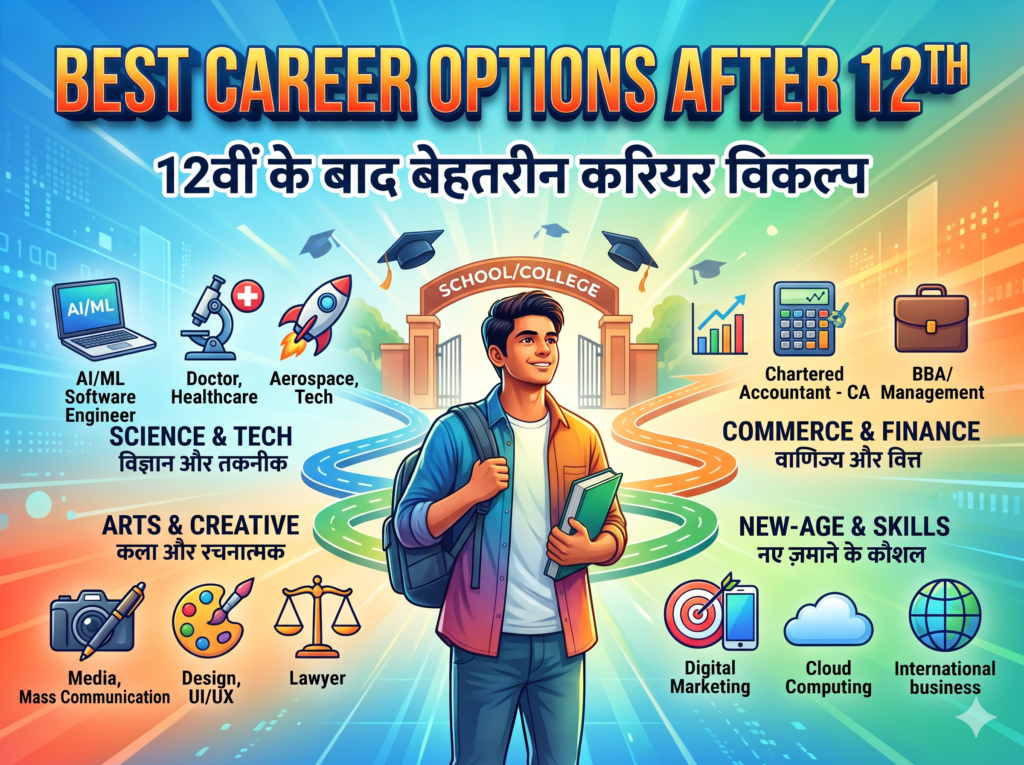
2. Engineering After 12th Science
Engineering is a popular choice for students who enjoy Mathematics, Physics, technology, and problem-solving.
Popular Engineering Courses
- B.Tech Computer Science Engineering
- B.Tech Artificial Intelligence
- B.Tech Information Technology
- B.Tech Mechanical Engineering
- B.Tech Civil Engineering
- B.Tech Electrical Engineering
- B.Tech Electronics and Communication Engineering
Eligibility
Students generally need Physics and Mathematics in Class 12. Other subject requirements and minimum marks depend on the college and admission rules.
Entrance Examination
JEE Main is one of the major entrance examinations for engineering admissions in India. Some colleges also use state-level examinations or their own admission processes.
Official website: https://jeemain.nta.nic.in/
Course Duration
A B.Tech degree generally takes four years to complete.
Career Opportunities
After completing an engineering degree, students may explore careers as software developers, mechanical engineers, civil engineers, electrical engineers, and other technical professionals.
Engineering can be a suitable choice for students who enjoy solving problems and working with technology.

3. Medical Career Options After 12th Science
Students who studied Physics, Chemistry, and Biology can explore different medical and healthcare courses.
MBBS
MBBS is a major educational pathway for students who want to become doctors.
- Eligibility: Students must meet the prescribed academic requirements and NEET-UG admission criteria.
- Duration: Generally 5.5 years, including the compulsory rotating internship.
- Career opportunities: Eligible graduates can work as doctors after completing the applicable registration requirements.
BDS
BDS stands for Bachelor of Dental Surgery. It focuses on dental health and oral healthcare.
- Duration: Generally five years, including the required internship.
- Career opportunities: Graduates may work in dental hospitals, clinics, and other dental healthcare settings after fulfilling the applicable requirements.
Other Medical Courses
Students can also consider:
- B.Sc Nursing
- Bachelor of Physiotherapy (BPT)
- Bachelor of Pharmacy (B.Pharm)
- Medical Laboratory Science
- Medical Imaging and Radiology
- Biotechnology
Admission requirements differ between courses and institutions, so students should check official eligibility rules before applying.
4. Computer Science and Information Technology
Computer Science is a useful option for students interested in programming, websites, mobile applications, software, and technology.
Popular Courses
- B.Tech Computer Science
- BCA (Bachelor of Computer Applications)
- B.Sc Computer Science
- B.Sc Information Technology
What Will You Learn?
Depending on the course, you may learn programming languages, website development, databases, computer networks, software engineering, and cybersecurity fundamentals.
Career Opportunities
Possible career paths include:
- Software Developer
- Web Developer
- Mobile App Developer
- IT Support Specialist
- Software Tester
- Database Administrator
Students can improve their career opportunities by developing practical skills, building projects, and gaining internship experience.
5. Artificial Intelligence and Data Science
Artificial Intelligence, commonly called AI, is a technology used to help computers perform tasks such as analysing information, recognising patterns, and solving problems.
Data Science focuses on analysing data to discover useful information and support decision-making.
Popular Courses
- B.Tech Artificial Intelligence and Machine Learning
- B.Tech Data Science
- B.Sc Data Science
- B.Sc Artificial Intelligence
- Computer Science degrees with AI specialisations
Important Skills
Students interested in these fields can start learning:
- Python programming
- Mathematics and statistics
- Data analysis
- Machine learning fundamentals
- Practical project development
Career Opportunities
Depending on qualifications and experience, students may explore roles such as data analyst, software developer, AI engineer, and machine learning engineer.
AI is an interesting field, but completing a course alone does not guarantee employment. Practical skills, education quality, and experience also matter.
6. Bachelor of Science (B.Sc.)
B.Sc is a good option for students who want to study scientific subjects in greater depth.
Popular B.Sc Courses
- B.Sc Physics
- B.Sc Chemistry
- B.Sc Mathematics
- B.Sc Biology
- B.Sc Computer Science
- B.Sc Biotechnology
- B.Sc Microbiology
- B.Sc Environmental Science
Course Duration
Many B.Sc programmes offer three-year degrees. Some universities also provide four-year honours or research programmes.
Career Opportunities
Depending on their specialisation, graduates may explore laboratory work, technical jobs, scientific research, education, and postgraduate study.
Some specialised positions require an M.Sc., Ph.D., or additional professional qualifications.
7. Pharmacy After 12th Science
Pharmacy focuses on medicines, pharmaceutical sciences, drug development, and the safe use of medicines.
Popular Courses
B.Pharm: Generally a four-year bachelor’s degree.
D.Pharm: Generally a two-year diploma programme.
Students must check the required subjects, marks, and admission rules for their selected institution.
Career Opportunities
Pharmacy graduates may explore opportunities in pharmaceutical manufacturing, quality control, quality assurance, drug safety, and other related areas.
Students who want to work as registered pharmacists in India must fulfil the applicable educational and registration requirements.
8. Nursing and Physiotherapy
Nursing and physiotherapy are healthcare fields that focus on patient care, recovery, rehabilitation, and improving quality of life.

B.Sc Nursing
B.Sc Nursing is generally a four-year course. Graduates may pursue nursing opportunities in hospitals, healthcare organisations, and community health services, subject to applicable requirements.
Bachelor of Physiotherapy (BPT)
Physiotherapy focuses on improving movement, physical function, and rehabilitation.
The course structure and duration can vary depending on the institution and applicable curriculum.
These courses may suit students who enjoy Biology, practical learning, and working in healthcare environments.
9. Architecture After 12th Science
Architecture can be a good option for students interested in drawing, designing buildings, creativity, and Mathematics.
Popular Course
B.Arch, or Bachelor of Architecture, is generally a five-year professional degree.
Students must satisfy the prescribed subject and admission requirements. Depending on the admission route, examinations such as NATA or JEE Main Paper 2 may be relevant.
Career Opportunities
Graduates may explore opportunities in architectural firms, building design, and related design and construction fields.
Students should check the current rules of the relevant professional authority and institution before applying.
10. Biotechnology and Microbiology
Biotechnology combines Biology and technology to develop useful products and processes. Microbiology focuses on microorganisms and their roles in health, food, industry, and the environment.
Popular Courses
- B.Sc Biotechnology
- B.Sc Microbiology
- B.Tech Biotechnology
- Other Life Science programmes
Career Opportunities
Depending on qualifications and experience, graduates may explore laboratory work, quality testing, pharmaceutical companies, research assistance, and postgraduate research.
Further education may be necessary for advanced scientific and research positions.
11. Defence Services After 12th Science
Students interested in discipline, leadership, and serving the country can explore eligible defence career pathways.
One recognised option is the National Defence Academy and Naval Academy examination conducted by UPSC.
Eligibility depends on age, educational subjects, medical standards, and other requirements mentioned in the current official notification.
Official website: https://upsc.gov.in/
Students should read the latest notification carefully before applying.
12. Agriculture and Environmental Science
Agriculture and Environmental Science can be suitable for students interested in plants, farming, food production, nature, and environmental protection.
Popular Courses
- B.Sc Agriculture
- Horticulture
- Forestry
- Environmental Science
- Food Science and Technology
Career Opportunities
Graduates may explore opportunities in agricultural businesses, food industries, environmental organisations, laboratories, and research.
Admission eligibility varies depending on the course and institution.
13. Career Options Without MBBS or B.Tech
Many students believe that MBBS and B.Tech are the only good choices after 12th Science. However, there are several other options.
Students can consider:
- BCA
- B.Sc Computer Science
- B.Sc Mathematics
- B.Sc Physics
- B.Pharm
- B.Sc Nursing
- BPT
- Biotechnology
- Agriculture
- Architecture
- Animation and Graphic Design
- Other professional courses
The best choice depends on your interests, academic background, budget, and long-term career goals.
14. PCM vs PCB vs PCMB: Which Is Better?
| Science Group | Popular Career Options |
|---|---|
| PCM | Engineering, Computer Science, Mathematics, Architecture |
| PCB | Medicine, Dentistry, Nursing, Pharmacy, Biotechnology |
| PCMB | Various eligible medical, engineering, and science courses |
PCM stands for Physics, Chemistry, and Mathematics. PCB stands for Physics, Chemistry, and Biology. PCMB includes all four subjects.
PCMB can provide access to a wider range of eligible courses, but students should also consider the additional academic workload.
15. Best Career Options Based on Your Interests
Choosing a career becomes easier when you understand what kind of work you enjoy.
| Your Interest | Courses to Consider |
|---|---|
| Computers and coding | B.Tech CSE, BCA, B.Sc Computer Science |
| Biology and healthcare | MBBS, BDS, Nursing, BPT |
| Mathematics and problem-solving | Engineering, Mathematics, Data Science |
| Chemistry and laboratory work | Chemistry, Pharmacy, Biotechnology |
| Drawing and creative design | Architecture, Animation, Graphic Design |
| Nature and agriculture | Agriculture, Forestry, Environmental Science |
| Research and discovery | B.Sc and further research programmes |
Use this table as a starting point and check the eligibility requirements of each course.
16. How to Choose the Right Career After 12th Science
Follow these seven steps to make a better career decision.
Step 1: Identify Your Interests
Think about the subjects you enjoy most, such as Mathematics, Biology, Physics, Chemistry, or Computer Science.
Step 2: Shortlist Three to Five Courses
Make a list of courses that match your interests and academic strengths.
Step 3: Check Eligibility
Review the required subjects, minimum marks, entrance examinations, and other admission conditions.
Step 4: Compare Colleges
Check the college’s recognition, curriculum, faculty, practical facilities, internship opportunities, and placement information.
Step 5: Calculate the Total Cost
Consider tuition fees, accommodation, transport, books, and other expenses. Research legitimate scholarships if needed.
Step 6: Research Career Opportunities
Understand the type of work available after completing each course and whether additional qualifications are required.
Step 7: Prepare an Admission Plan
Write down application deadlines, entrance examination dates, and preparation requirements.
17. Important Entrance Examinations After 12th Science
Depending on the course, students may need to appear for one of the following examinations:
- JEE Main: For eligible engineering programmes and other specified admissions.
- NEET-UG: For specified undergraduate medical admissions.
- CUET-UG: For participating universities and programmes.
- NATA: For relevant architecture admission pathways.
- NDA/NA Examination: For eligible defence career pathways.
- State and university entrance examinations: For selected courses and institutions.
Not every course requires an entrance examination. Always check the latest official admission information.
18. Common Mistakes to Avoid
Students should avoid these common mistakes when choosing a career:
- Choosing a course only because friends are choosing it.
- Assuming that expensive colleges always provide better jobs.
- Believing that an AI course guarantees a high-paying job.
- Ignoring eligibility criteria and application deadlines.
- Selecting a course without checking the total fees.
- Thinking that MBBS and B.Tech are the only valuable options.
- Ignoring practical skills, internships, and further education requirements.
Researching your options and planning carefully can help you make a more informed decision.
19. Frequently Asked Questions (FAQs)
Q1. Which is the best career option after 12th Science?
There is no single best career for every student. Engineering, medicine, Computer Science, pharmacy, nursing, agriculture, architecture, and research can all be suitable options.
Q2. What can I study after 12th Science PCM?
Students with PCM can explore engineering, Computer Science, Mathematics, Physics, Architecture, Data Science, and other courses that accept their subject combination.
Q3. What can I study after 12th Science PCB?
Students with PCB can explore medicine, dentistry, nursing, pharmacy, physiotherapy, biotechnology, microbiology, and other eligible healthcare and life-science courses.
Q4. Can I study Computer Science after 12th Science?
Yes. Depending on eligibility, students can consider B.Tech Computer Science, BCA, B.Sc Computer Science, and related programmes.
Q5. Can I study AI after 12th Science?
Yes. Students can explore AI-related degrees and Computer Science programmes with AI specialisations. Programming, Mathematics, statistics, and practical projects can be useful.
Q6. Is NEET compulsory for every medical-related course?
No. NEET-UG is required for specified medical admissions, including MBBS and BDS. Other healthcare courses may have different admission requirements.
Q7. Can I get a job after B.Sc?
Yes. Some entry-level jobs are available depending on the subject, skills, and employer requirements. Certain specialised careers require postgraduate education.
Q8. How can I choose a good college?
Compare recognition, course fees, facilities, faculty, internships, placement information, and student support before making a decision.